
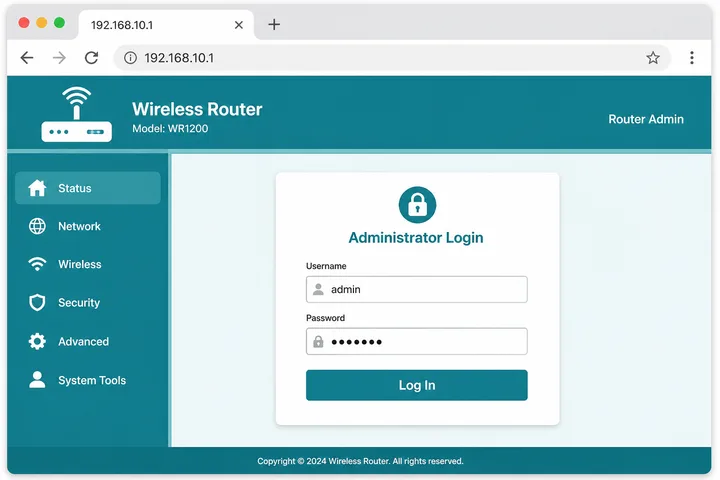
192.168.10.1 is a private home/router admin gateway used on some WiFi routers and ISP units. Type http://192.168.10.1 in your browser address bar while connected to that network to open the login page.
Key Takeaways
- 192.168.10.1 is a home/router admin gateway — open with
http://192.168.10.1. - It is not the same as 192.168.1.1, 192.168.0.1, or 10.0.0.1.
- If it fails, verify the real gateway before factory reset.
- Related: 10.0.0.1 · Piso WiFi · Gateway checker · 192.168.0.1
This guide covers what 192.168.10.1 is, how to log in, default passwords, fixes when it will not load, and how it compares to 192.168.1.1, 192.168.0.1, and 10.0.0.1.
On this page: What it is · How to log in · Default passwords · Typos · vs other gateways · Not working · FAQ
What Is 192.168.10.1?
192.168.10.1 is a private IPv4 address in the 192.168.0.0/16 range. Some home routers and ISP-branded gateways use it as the default LAN admin / gateway address.
It is not a public website. It only works on devices connected to that router’s WiFi or Ethernet. If your sticker or manual lists 192.168.10.1, this is the address to use — not 192.168.1.1 by habit.
How to Log in to 192.168.10.1
Connect to the router network, open a browser, type http://192.168.10.1 in the address bar, then sign in with the admin credentials from the label or manual.
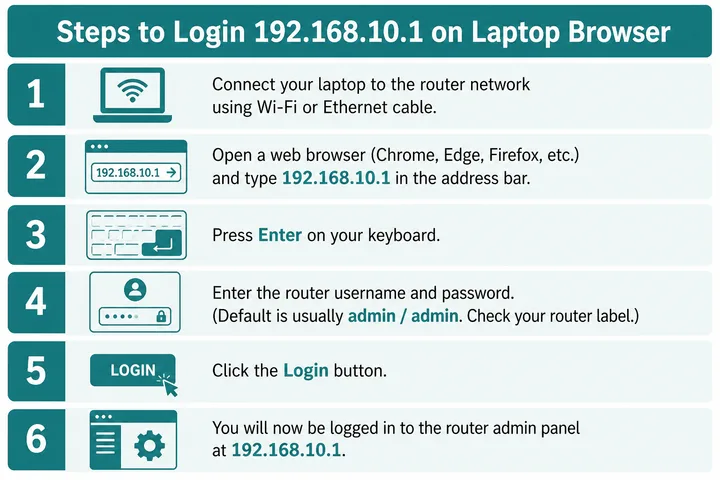
- Connect to the router WiFi or LAN cable.
- Turn off VPN; on phones, turn off mobile data.
- Open Chrome / Edge / Safari.
- Type
http://192.168.10.1→ Enter. - Sign in with admin username and password.
If the page fails, try 192.168.1.1, 192.168.0.1, or 10.0.0.1 — or run the gateway checker.
Default Passwords for 192.168.10.1
Check the sticker under the router first. Common pairs:
| Brand / type | Username | Password |
|---|---|---|
| Many home routers | admin | admin |
| Some ISP units | admin | password |
| TP-Link / Tenda (some models) | admin | admin |
| D-Link (some) | admin | (blank) or admin |
| ISP modem/router | printed on sticker | printed on sticker |
Admin password ≠ WiFi password. One opens settings; the other joins the wireless network.
192.168.10.1 Typos and Mistypes
Spaces, letter L, and swapped octets send you to the wrong place. Use 192.168.10.1 exactly when that is your gateway.
| Typed | Use |
|---|---|
| 192.168.10.l (letter L) | 192.168.10.1 |
| 192.168.1.0 / 192.168.1.1 (habit) | Only if that is your real gateway |
| 192 168 10 1 / 192-168-10-1 | 192.168.10.1 |
| https://192.168.10.1 | Try http:// first |
| 192.168.100.1 | Different address (often Huawei ONT) |
192.168.10.1 vs 192.168.1.1 / 192.168.0.1 / 10.0.0.1
These are different private gateway addresses. Use the one your router assigned — do not assume 192.168.1.1.
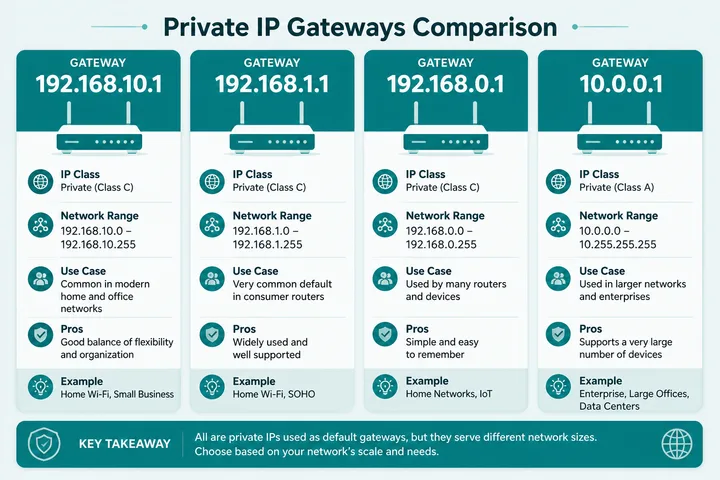
| Address | Typical use | Note |
|---|---|---|
| 192.168.10.1 | Some home / ISP routers | Primary focus of this page |
| 192.168.1.1 | Very common home / ISP routers | Most frequent default worldwide |
| 192.168.0.1 | Many home routers | Netgear / D-Link / Tenda-style |
| 10.0.0.1 | Some routers + Piso portals | See Piso WiFi |
192.168.10.1 Not Working
Most failures are wrong WiFi, wrong IP, or VPN. Work this table:
| Problem | Fix |
|---|---|
| Page will not load | Stay on this router’s WiFi; try http; disable VPN |
| Habit of typing 192.168.1.1 | Confirm sticker / WiFi gateway first |
| Wrong gateway | Gateway checker or WiFi details |
| Login rejected | Use sticker password; reset only if you accept wiping settings |
| Phone uses mobile data | Turn mobile data off |
Sources, Scope, and Corrections
Claim basis: Network behavior is separated from common portal defaults. Addresses, buttons, rates, credentials, and session behavior can vary by firmware, platform, owner configuration, and device. See our Editorial Policy for claim labels and source priorities.
Found a mismatch? Send the page URL and privacy-safe evidence using the correction process. This block does not claim a hands-on test or a fact-review date.
When 192.168.10.1 Appears on Vendo and Repeater Setups
Repeaters and small business routers on this address are commonly Tenda or TP-Link hardware, so use those guides for menu names and default-credential caveats. If the browser lands on a paid sign-in screen instead of firmware, read captive portal before changing anything.
192.168.10.1 shows up on some business routers, range extenders, and vendo backhaul devices. It is a LAN admin candidate, not a universal Piso WiFi customer portal. Customers paying for timed WiFi should still look for the hotspot portal address printed by the owner — often 10.0.0.1 — even if the upstream router admin uses 192.168.10.1.
Owners should label both addresses clearly: one for customer captive-portal access, one for router configuration. Mixing them causes password resets on the wrong interface and session outages during maintenance.
Related Guides
- Router IP address list — Compare common and uncommon private gateways
- Default gateway guide — Find the router address used by your device
- Gateway checker — Find the correct local router or portal address
- What is an IP address? — Understand IPv4, IPv6, public and private addresses
FAQ
What Is 192.168.10.1?
192.168.10.1 is a private IPv4 address used as the default admin gateway on some home routers and ISP-branded WiFi devices.
How Do I Log in to 192.168.10.1?
Connect to the router WiFi or Ethernet, type http://192.168.10.1 in the browser address bar, then enter the admin username and password from the device sticker.
Is 192.168.10.1 the Same as 192.168.1.1?
No. They are different private gateway addresses. Many routers use 192.168.1.1; some models and ISPs use 192.168.10.1.
Is 192.168.10.1 the Same as 10.0.0.1?
No. 192.168.10.1 is typically home/router admin; 10.0.0.1 is used by some routers and by many Piso WiFi portals.
192.168.10.1 Not Working — What Next?
Confirm you are on that router’s WiFi, try http not https, disable VPN and mobile data, and verify the real gateway with WiFi details or the gateway checker.