
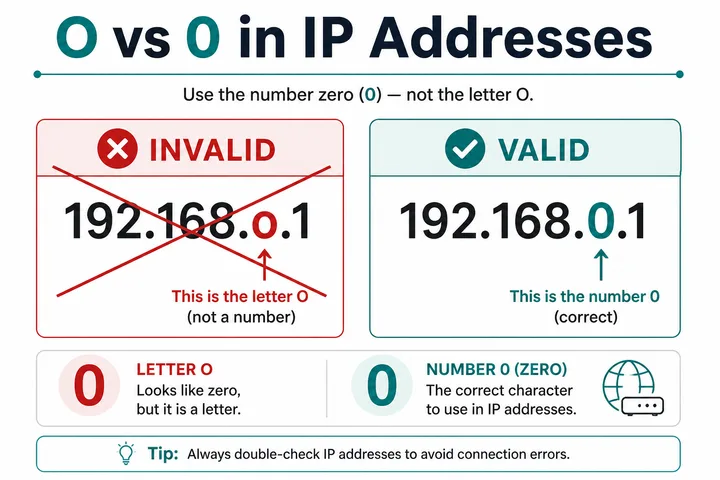
192.168.o.1 (with the letter O) is not a valid IP address. The correct gateway is 192.168.0.1 — with the number zero. Type http://192.168.0.1 in your browser address bar to open many home router admin pages.
Key Takeaways
- 192.168.o.1 (letter O) is invalid → use 192.168.0.1.
- Open with
http://192.168.0.1on the correct WiFi. - If it fails, verify the real gateway — it may be 192.168.1.1 or 10.0.0.1.
- Related: 10.0.0.1 · Piso WiFi · Gateway checker
This page covers the letter-O typo that people search, how to log in to 192.168.0.1, default passwords, fixes when it will not load, and how it differs from Piso WiFi’s common portal 10.0.0.1.
On this page: Letter-O typo · What is 192.168.0.1 · How to log in · Passwords · vs 10.0.0.1 · Not working · FAQ
192.168.o.1 vs 192.168.0.1 — Letter O vs Zero
192.168.o.1 uses the letter O in the third octet. IP addresses only use digits 0–255, so that string is invalid. The working address is 192.168.0.1 with a zero.
Why the typo spreads: fonts make 0 and O look alike, stickers get misread, and people retype from memory into Google. Searching 192.168.o.1 still means “open my router at 192.168.0.1.”
| 192.168.o.1 | 192.168.0.1 | |
|---|---|---|
| Third octet | Letter O | Digit 0 |
| Valid IPv4? | No | Yes |
| Opens router admin? | No (as typed) | Yes, if that is your gateway |
| What to type | Never | http://192.168.0.1 |
Related Mistypes
| Typed | Use |
|---|---|
| 192.168.o.1 / 192.168.O.1 | 192.168.0.1 |
| 192.168.0.l (letter L) | 192.168.0.1 |
| 192.168.0.l tenda / 192.168.o.1 tenda | 192.168.0.1 (then Tenda login) |
| 192 168 0 1 / 192-168-0-1 | 192.168.0.1 |
| https://192.168.0.1 | Try http:// first |
What Is 192.168.0.1?
192.168.0.1 is a private IPv4 address in the 192.168.0.0/16 RFC 1918 range. Many home routers use it as the default gateway / LAN admin address.
It is not a public website. It only works on devices connected to that router’s WiFi or Ethernet. Brands that commonly ship with 192.168.0.1 include many Netgear, D-Link, TP-Link (some models), Tenda, and ISP-branded gateways.
How to Log in to 192.168.0.1
Connect to the router network, open a browser, type http://192.168.0.1 in the address bar, then enter the admin username and password from the sticker or manual.
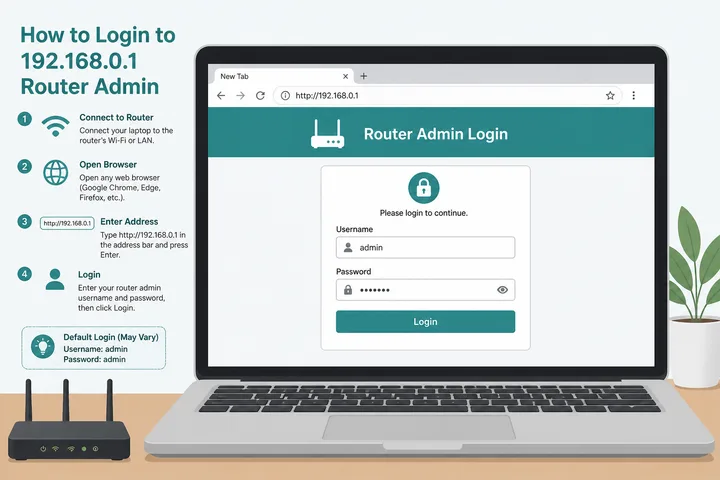
- Connect to the router WiFi or LAN cable.
- Turn off VPN and, on phones, turn off mobile data if it hijacks routing.
- Open Chrome / Edge / Safari.
- Type
http://192.168.0.1(zeros, not letter O) → Enter. - Sign in with admin credentials.
If the page fails, your gateway may be 192.168.1.1 or 10.0.0.1 instead — use the gateway checker.
Default Passwords for 192.168.0.1
Defaults vary by brand. Check the label under the router first. Common pairs:
| Brand / type | Username | Password |
|---|---|---|
| Netgear | admin | password |
| D-Link | admin | (blank) or admin |
| TP-Link (some) | admin | admin |
| Tenda | admin | admin |
| Belkin | admin | (blank) or password |
| ISP modem/router | printed on sticker | printed on sticker |
Admin password ≠ WiFi password. One opens settings; the other joins the wireless network.
192.168.0.1 vs 10.0.0.1 vs 192.168.1.1
Brand matters more than the address once you are logged in. Units on this gateway are frequently TP-Link or Tenda, and their menu paths differ even when the IP matches. If the numbering itself is unclear, what is an IP address explains why this stays inside your local network, while 192.168.10.1 covers the nearby business and repeater gateway.
These are different private gateway addresses. Use the one your router actually assigned — guessing the wrong one wastes time.
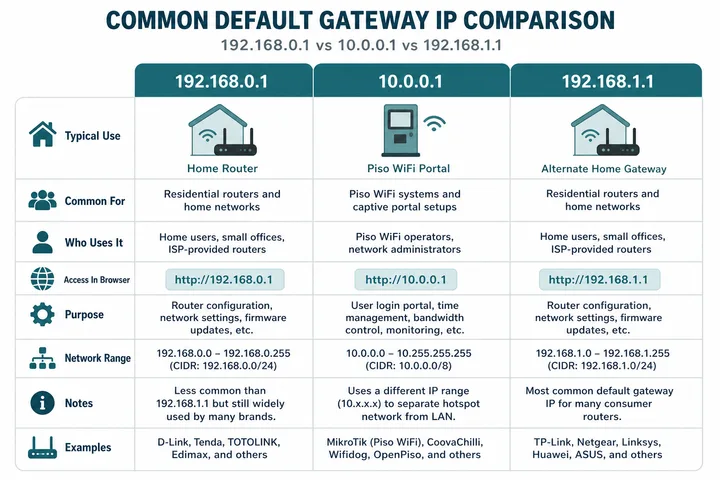
| Address | Typical use | Philippines note |
|---|---|---|
| 192.168.0.1 | Many home routers | Netgear/D-Link/Tenda-style admin |
| 192.168.1.1 | Very common home / ISP routers | Many PLDT / Globe / Converge units |
| 10.0.0.1 | Some routers + most Piso WiFi portals | See 10.0.0.1 and Piso WiFi |
192.168.0.1 Not Working
| Problem | Fix |
|---|---|
| Typed 192.168.o.1 | Replace letter O with zero: 192.168.0.1 |
| Page won’t load | Confirm you are on this router’s WiFi; try http not https; disable VPN |
| Wrong gateway | Check gateway in WiFi details or use gateway checker |
| Login rejected | Use sticker password; reset only if you accept wiping settings |
| Phone uses mobile data | Turn mobile data off |
Sources, Scope, and Corrections
Claim basis: Network behavior is separated from common portal defaults. Addresses, buttons, rates, credentials, and session behavior can vary by firmware, platform, owner configuration, and device. See our Editorial Policy for claim labels and source priorities.
Found a mismatch? Send the page URL and privacy-safe evidence using the correction process. This block does not claim a hands-on test or a fact-review date.
Why 192.168.o.1 Breaks and 192.168.0.1 Works
Searchers often type the letter O because fonts make zero and O look alike on stickers and phone keyboards. Browsers and OS network stacks require numeric octets, so 192.168.o.1 never resolves as a private IPv4 address. Correct the typo to 192.168.0.1, keep mobile data off, and stay on the router WiFi. If the page still fails, your LAN may use a different gateway such as 192.168.1.1 — confirm with the gateway checker instead of repeating the letter-O URL.
This page owns the letter-O typo intent for the 192.168.0.x family. Do not treat it as a Piso WiFi portal guide; coin/voucher portals usually live at 10.0.0.1 on a separate hotspot SSID.
Related Guides
- Router IP address list — Compare common and uncommon private gateways
- Default gateway guide — Find the router address used by your device
- Gateway checker — Find the correct local router or portal address
- What is an IP address? — Understand IPv4, IPv6, public and private addresses
FAQ
Is 192.168.o.1 a Real IP?
No. Use 192.168.0.1 with a zero.
How Do I Open 192.168.0.1?
Type http://192.168.0.1 in the browser address bar while connected to that router.
Is 192.168.0.1 the Same as 10.0.0.1?
No. Different private addresses. Piso WiFi portals often use 10.0.0.1; many home routers use 192.168.0.1 or 192.168.1.1.
192.168.o.1 Tenda — What Do I Do?
Open http://192.168.0.1 (zero), then log in with the Tenda admin credentials on the device label (often admin/admin).